Municipality
Economic Profile and Business Opportunities in Tysnes Municipality
An analytical overview of industry composition, employment dynamics, and geographical commercial nodes in Tysnes
Executive Summary
Tysnes is an island municipality in Vestland county characterized by a dual economic foundation: a high-value industrial aquaculture sector alongside a sizable public administration and social care footprint. Commercial revenue in the municipality is anchored by salmon farming, aquaculture services, and associated technical maritime activities, which together generate hundreds of millions of NOK in annual turnover.
Key structural highlights of the Tysnes economy include:
- High Revenue Marine Sector: Fish farming and specialized aquaculture service providers represent the dominant share of private sector revenue and operating profit.
- Geographical Concentration: Commercial turnover is heavily concentrated in hubs such as Onarheim and Tysnes, whereas Uggdal serves as the administrative and employment core for public services.
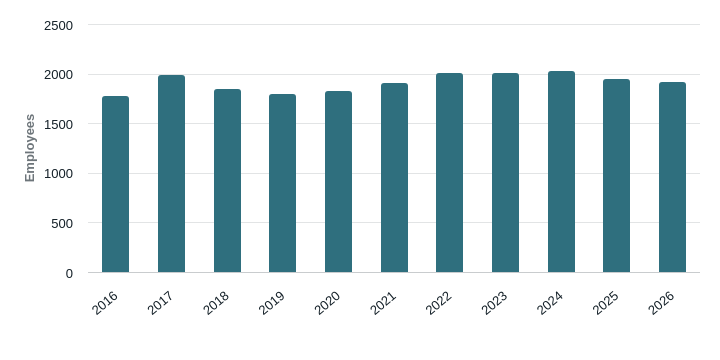
- Stable Labor Force: Local employment has remained resilient, stabilizing near 1,900 to 2,000 employees over recent years.
For entrepreneurs and prospective investors, Tysnes presents targeted opportunities within specialized marine services, technical consulting, local retail, and tourism-related enterprises.
Economic Overview
The overall economic performance of Tysnes reflects the cyclical dynamics typical of Norway's coastal aquaculture economies. Total corporate revenue exhibits noticeable year-over-year fluctuations driven by global market conditions, harvest schedules, and biomass values in the fish farming sector, whereas employment numbers remain comparatively steady.
Historical Revenue & Employment Trends
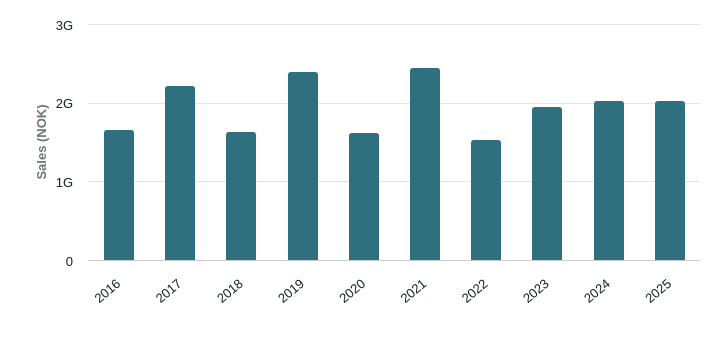
Corporate sales peaked in 2021 at over NOK 2.44 billion, followed by normalizations and strong rebounds in 2023–2024. Total employment has expanded from 1,771 in 2016 to over 2,000 workers in recent years.
| Year | Corporate Revenue (NOK) | YoY Sales Growth | Employment (Workers) | YoY Employment Growth |
|---|---|---|---|---|
| 2016 | 1,651.4M | — | 1,771 | — |
| 2017 | 2,206.5M | +33.6% | 1,983 | +12.0% |
| 2018 | 1,623.8M | -26.4% | 1,849 | -6.8% |
| 2019 | 2,395.9M | +47.5% | 1,799 | -2.7% |
| 2020 | 1,617.5M | -32.5% | 1,829 | +1.7% |
| 2021 | 2,444.6M | +51.1% | 1,907 | +4.3% |
| 2022 | 1,526.8M | -37.5% | 2,005 | +5.1% |
| 2023 | 1,939.5M | +27.0% | 2,005 | 0.0% |
| 2024 | 2,024.6M | +4.4% | 2,031 | +1.3% |
| 2025 | 2,021.3M | -0.2% | 1,944 | -4.3% |
Note: Figures for 2025–2026 reflect projected economic cycles based on reported corporate statistics.
Industry Structure & Legal Forms
The economy of Tysnes is driven by primary production, maritime support, and civil public services. While municipal and public services account for a high head-count, aquaculture and technical consulting produce the vast majority of commercial EBITDA.
Key Industry Groups
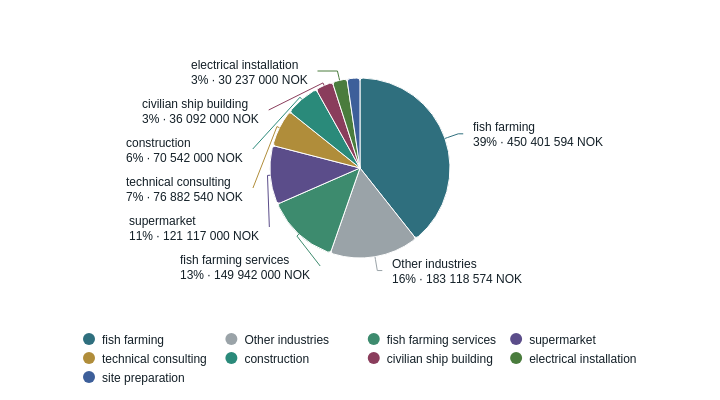
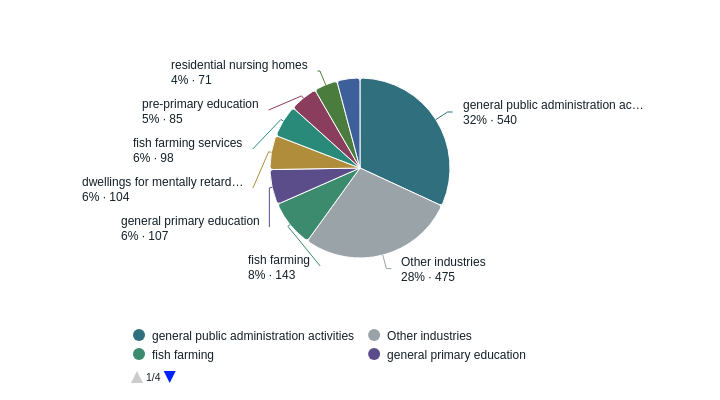
- Aquaculture & Marine Services: Fish farming across 7 registered companies accounts for NOK 721.9M in operating income, NOK 61.0M in EBITDA, and 143 employees. Specialized fish farming services add another 4 companies generating NOK 207.1M in revenue with 98 employees and an average EBITDA margin of 17%.
- Public Administration & Education: General public administration employs 540 people across 2 entities, while primary education accounts for 107 employees across 3 schools.
- Health & Residential Care: Dwellings for disabled care (104 employees), residential nursing homes (71 employees), and home care services (42 employees) form a crucial social care ecosystem.
- Commercial Trade & Retail: Supermarkets (4 companies, 70 employees, NOK 125.6M operating income) provide steady localized consumer trade.
- Technical Consulting & Construction: Technical consulting boasts strong profitability with NOK 77.9M operating income and a 14% EBITDA margin across 25 employees. Construction comprises 8 companies with 56 employees.
Business Organization Types
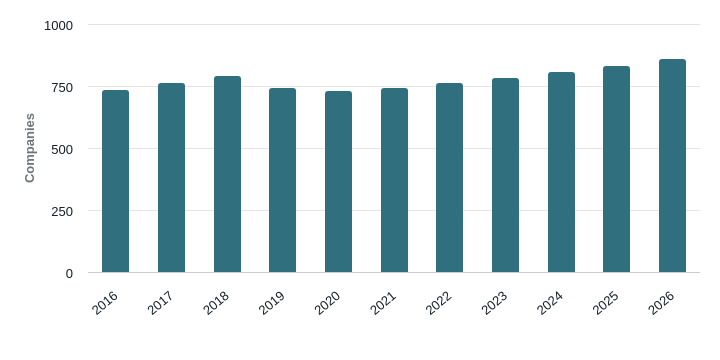
Limited liability companies (AS) dominate the commercial landscape, generating NOK 1.46 billion in operating income across 801 employees.
| Legal Form | Number of Companies | Total Employees | Operating Income (NOK) | Operating Margin |
|---|---|---|---|---|
| Aksjeselskap (AS) | 74 | 801 | 1,464.7M | 5% |
| Organisasjonsledd (ORGL) | 26 | 520 | 0.0M | — |
| Kommune (KOMM) | 1 | 519 | 0.0M | — |
| Enkeltpersonforetak (ENK) | 13 | 66 | 0.0M | — |
| Særlig organisasjonsform (SÆR) | 1 | 13 | 11.1M | 0% |
| Interkommunalt selskap (IKS) | 1 | 4 | 10.7M | 0% |
Business Geography & Commercial Hubs
Economic activity in Tysnes is distributed across several key population centers, each serving distinct functions within the municipal ecosystem:
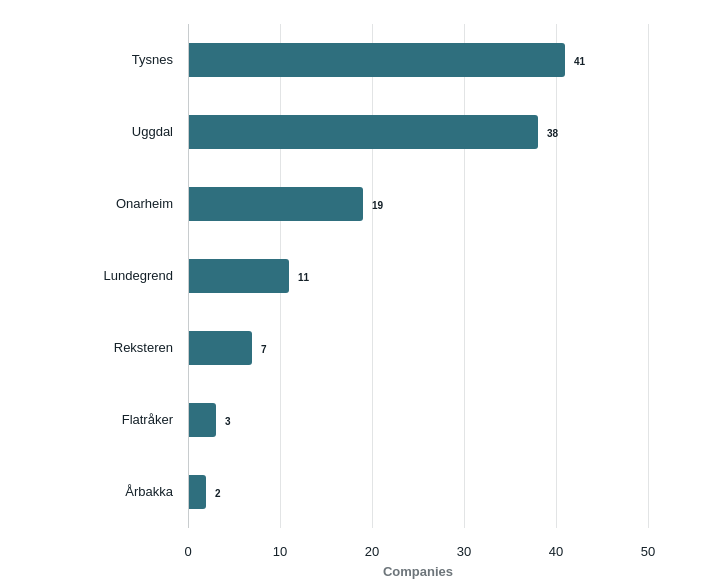
- Onarheim: The financial and industrial heavy-weight of Tysnes. Home to 19 companies and 310 employees, Onarheim generates NOK 612.1M in operating income and NOK 424.4M in sales revenue. It boasts an 8% EBITDA margin and strong revenue growth (+14%), driven primarily by corporate aquaculture headquarters.
- Tysnes (Village/Center): Represents 41 companies and 469 employees with NOK 557.7M in operating income and NOK 542.7M in sales. Operating margins average 6% with a healthy EBITDA margin of 9%.
- Uggdal: The principal administrative hub. Houses 38 companies and 1,057 employees, predominantly in municipal and public sector roles. Operating income totals NOK 122.5M.
- Lundegrend: Represents 11 companies with 66 employees, generating NOK 37.4M in operating income.
- Reksteren: Features 7 registered companies and 42 employees, generating NOK 45.3M in operating income.
- Flatråker: Includes 3 specialized companies employing 11 workers, with total operating income reaching NOK 130.0M.
- Årbakka: Comprises 2 registered companies with 9 workers.
Largest Employers
Employment in Tysnes is shared between public welfare operations and private maritime enterprises. The largest local employers include:
- Tysnes Kommune (Uggdal) — 519 employees (General public administration)
- Tysnes Omsorgssenter (Uggdal) — 71 employees (Residential nursing care)
- Heras Norway AS Avd Tysnes (Tysnes) — 61 employees (Textile & sewing machine equipment supplier)
- Tysnes Skule (Tysnes) — 44 employees (Primary education)
- Uggdal Skule (Uggdal) — 44 employees (Primary education)
- Alsaker Fjordbruk AS (Onarheim) — 42 employees (Fish farming; NOK 243.5M operating income, NOK 13.6M EBITDA)
- Pleie Og Omsorgstenesta I Tysnes (Uggdal) — 42 employees (Home health services)
- Stendi AS Ot Hovland (Onarheim) — 41 employees (Specialized residential care)
- Haaheim Gaard Torstein Hatlevik (Uggdal) — 37 employees (Mixed farming & hospitality)
- Fjordbruk Service AS (Onarheim) — 35 employees (Fish farming services; NOK 119.7M operating income, NOK 26.6M EBITDA)
- Nordsjø Fjordbruk AS Avd Tysnes (Onarheim) — 33 employees (Fish farming)
- Spar Tysnes AS (Tysnes) — 33 employees (Supermarket retail; NOK 61.4M operating income, NOK 4.7M EBITDA)
- Stjernereiso Barnehage (Uggdal) — 33 employees (Pre-primary education)
- Lerøy Vest AS Avd Tysnes (Tysnes) — 30 employees (Fish farming; NOK 257.1M operating income, NOK 32.4M EBITDA)
- Onarheim Bruk AS (Onarheim) — 27 employees (Fish farming; NOK 67.8M operating income, NOK 21.0M EBITDA, +49% growth)
Business Dynamism & Market Stability
The commercial environment in Tysnes demonstrates strong structural stability, characterized by low bankruptcy rates and well-capitalized anchor industries.
Bankruptcy Analysis
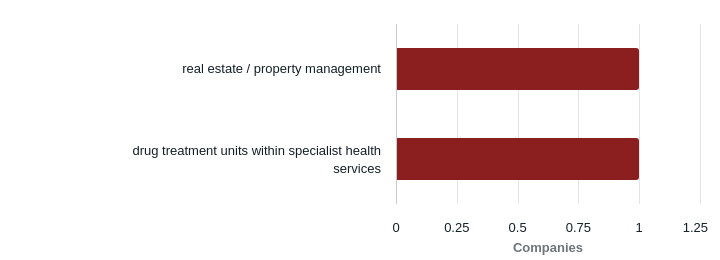
Recent bankruptcy data lists only two corporate insolvencies in the municipality:
- Mestringshusene Tysnes AS (Uggdal) — Drug treatment specialist unit (0 employees, NOK 0 sales at closure).
- Tysnes Sjø Og Fritid Eiendom AS (Uggdal) — Real estate management company (0 employees, NOK 0 sales at closure).
This low rate of corporate failure highlights the stability of the local economy, where strong primary industries anchor supply chains and maintain consistent regional demand.
Opportunities for Founders & Investors
For new business founders, Tysnes offers attractive avenues in high-margin service sectors and niche market gaps:
- Aquaculture Supply & Technical Services: With fish farming service providers enjoying 17% to 22% EBITDA margins and technical consulting achieving 14% EBITDA margins, specialized sub-contracting and technological service firms have strong growth potential.
- Hospitality & Local Experience Services: High-profile local destinations like Haaheim Gaard demonstrate demand for premium tourism, culinary experiences, and coastal recreation.
- Commercial Construction & Site Services: Subcontracting in electrical installation (NOK 30.4M revenue, 6% margin) and specialized site preparation provides room for agile local firms.
- Retail & Consumer Services: Grocery retail remains healthy (Spar Tysnes generating NOK 61.4M in sales), signaling potential for supplementary specialized retail or consumer service concepts.
Founders evaluating site selection, business categories, or address data across Tysnes can utilize platforms like SmartGrunder to explore commercial niches and local market dynamics.
Conclusion
Tysnes stands out as a robust coastal economy in Vestland, driven by world-class aquaculture operators in Onarheim and Tysnes, complemented by a substantial municipal public service center in Uggdal. The municipality boasts strong corporate revenues, low bankruptcy risk, and profitable opportunities for specialized service providers supporting the local marine and tourism ecosystems.