Municipality
Vadsø Economic Overview & Founder Guide
An in-depth analysis of industry structure, public sector anchors, employment trends, and commercial opportunities in Vadsø municipality.
Executive Summary
Vadsø serves as a key administrative center in Eastern Finnmark, defined by a unique dual structure: a massive, highly stable public sector footprint paired with robust commercial clusters in trade, automotive services, energy, and logistics. As the seat of county functions and regional state governance, Vadsø maintains a resilient economic foundation that shelters local businesses from extreme cyclical swings.
Key economic highlights include:
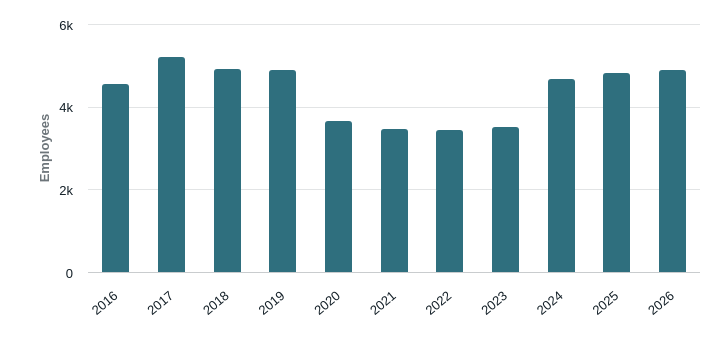
- Rebound in Workforce: Total local workforce rebounded strongly to 4,672 employees in 2024 (+33.0% YoY) and is projected to reach 4,877 employees by 2026.
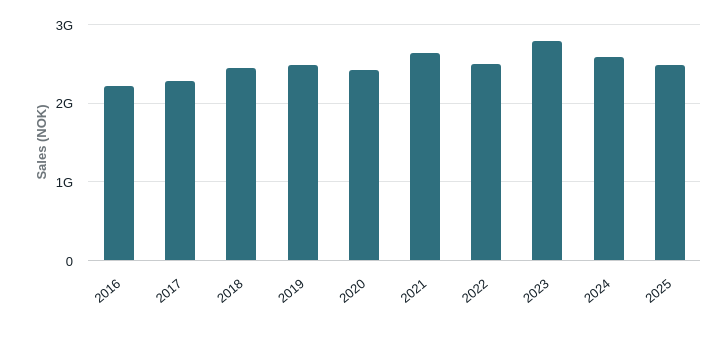
- Substantial Commercial Turnover: Local corporate turnover peaked at NOK 2.79 billion in 2023, stabilizing at NOK 2.48–2.57 billion in 2024–2025.
- Public Sector Anchor: Public administration alone accounts for over 1,750 employees across regional and state bodies like Finnmark Fylkeskommune and Statsforvalteren.
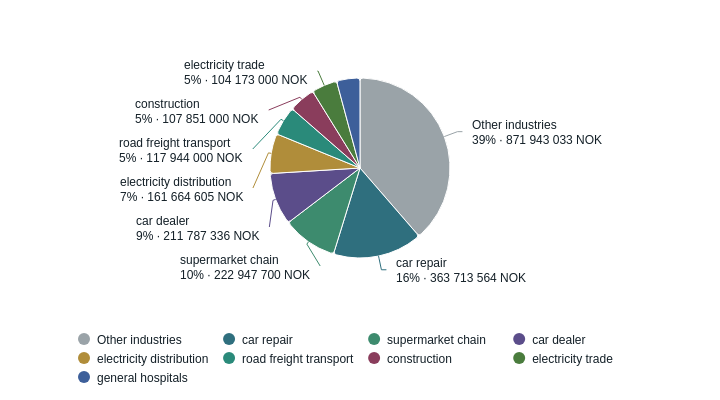
- Commercial Strongholds: Automotive retail and repair generate over NOK 570 million in combined revenue, alongside strong performance in supermarket chains (NOK 222.9M), electricity distribution (NOK 161.7M), and road freight (NOK 117.9M).
For entrepreneurs and investors, Vadsø offers a captive customer base driven by stable public payrolls, high local purchasing power, and demand for specialized B2B services, infrastructure, and consumer offerings.
Macroeconomic Overview: Sales & Employment
Vadsø's economic indicators reveal a period of realignment followed by robust expansion in total employment. Turnover for local businesses expanded from NOK 2.21 billion in 2016 to a high of NOK 2.79 billion in 2023, before moderating to NOK 2.57 billion in 2024 and an estimated NOK 2.48 billion in 2025.
Historical Revenue & Workforce Trends
| Year | Corporate Sales (NOK) | Sales YoY Change | Total Employees | Employment YoY Change |
|---|---|---|---|---|
| 2016 | 2,214.5M | - | 4,556 | - |
| 2017 | 2,277.0M | +2.8% | 5,194 | +14.0% |
| 2018 | 2,446.8M | +7.5% | 4,904 | -5.6% |
| 2019 | 2,478.8M | +1.3% | 4,889 | -0.3% |
| 2020 | 2,417.3M | -2.5% | 3,656 | -25.2% |
| 2021 | 2,629.9M | +8.8% | 3,455 | -5.5% |
| 2022 | 2,488.4M | -5.4% | 3,446 | -0.3% |
| 2023 | 2,787.5M | +12.0% | 3,512 | +1.9% |
| 2024 | 2,574.4M | -7.6% | 4,672 | +33.0% |
| 2025 (est.) | 2,477.7M | -3.8% | 4,803 | +2.8% |
| 2026 (est.) | - | - | 4,877 | +1.5% |
Note: Figures for 2025–2026 represent data-grounded estimations based on current municipal growth trajectories.
The sharp employment growth in 2024 reflects both institutional restructuring and formal reporting updates across county and municipal entities, solidifying Vadsø's role as a major regional employment center.
Industry Structure & Legal Forms
Vadsø's business composition displays a distinct mix of public administration, social services, and specialized commercial operations.
Top Commercial & Administrative Sectors
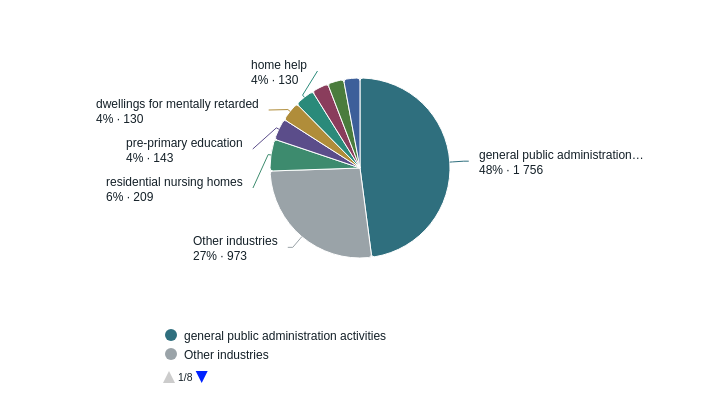
- General Public Administration: 7 entities employing 1,756 people, forming the primary foundation of local employment.
- Automotive & Mechanics: Car repair (NOK 372.4M operating income across 5 companies) and car dealerships (NOK 213.7M operating income across 4 companies) form the largest private revenue driver in the area.
- Supermarkets & Grocery Trade: 3 major supermarket chains generate NOK 230.8M in operating income (NOK 222.9M sales) with 65 employees.
- Energy & Utilities: Electricity distribution generates NOK 164.0M in operating income with an impressive 27% EBITDA margin (NOK 44.4M EBITDA).
- Logistics & Contracting: Road freight transport (NOK 117.9M sales, 107 employees) and site preparation (NOK 23.7M sales, 25% EBITDA margin) demonstrate strong profitability in physical operations.
- Healthcare & Care Services: Includes residential nursing homes (209 employees), pre-primary education (143 employees), home help (130 employees, NOK 23.1M sales), and general primary education (110 employees).
Organizational Form Distribution
| Legal Form | Number of Entities | Total Employees | Operating Income (NOK) | Sales Revenue (NOK) |
|---|---|---|---|---|
| AS (Aksjeselskap) | 182 | 1,519 | 2,458.5M | 2,332.1M |
| FYLK (Fylkeskommune) | 1 | 1,385 | 0.0M | 0.0M |
| KOMM (Kommune) | 33 | 920 | 0.0M | 0.0M |
| ORGL (Organisasjonsledd) | 25 | 785 | 0.0M | 0.0M |
| SÆR (Særskilt organisert) | 4 | 134 | 245.4M | 190.0M |
| ENK (Enkeltpersonforetak) | 13 | 87 | 0.0M | 0.0M |
Limited liability companies (AS) drive nearly all commercial market transactions, generating NOK 211.9M in total EBITDA across the municipality.
Business Geography: Vadsø Town vs. Vestre Jakobselv
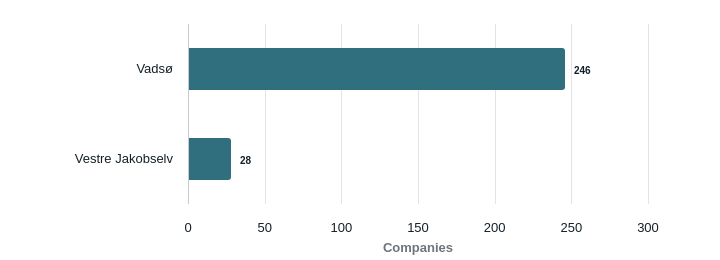
Commercial and public sector activity in Vadsø is concentrated in two primary geographical areas: the administrative center of Vadsø town and the secondary hub of Vestre Jakobselv.
Geographical Breakdown
| Location | Companies | Employees | Operating Income (NOK) | Sales Revenue (NOK) | Operating Margin |
|---|---|---|---|---|---|
| Vadsø | 246 | 4,748 | 2,516.6M | 2,275.6M | 2% |
| Vestre Jakobselv | 28 | 210 | 330.4M | 326.9M | 4% |
Spatial Characteristics
- Vadsø (Town Center & Industrial Zones): Houses all state and regional government offices, main commercial centers, car dealerships, health institutions, and transport hubs. Total corporate EBITDA in Vadsø reaches NOK 246.5M.
- Vestre Jakobselv: Serves as a vital secondary cluster with 28 active businesses generating NOK 326.9M in sales, operating with a higher average operating margin (4%) driven by localized contracting, trade, and primary production.
Largest Employers in Vadsø
Employment in Vadsø is anchored by regional government institutions, healthcare networks, and logistics/service providers. Below are the key employers reported in the municipality:
Major Institutions & Employers
- Finnmark Fylkeskommune: 1,385 employees — County administration headquarters.
- Finnmark Fylkeskommune Sentraladministrasjonen Vadsø: 170 employees — Central administration office.
- Statsforvalteren I Troms Og Finnmark: 133 employees — Regional State Governor administration.
- Vadsø Kommune Finnstjerna Bofellesskap: 130 employees — Municipal care and specialized residential facility.
- Vadsø Bo Og Omsorgssenter: 95 employees — Municipal nursing and care center.
- Vadsø Videregående Skole: 73 employees — Secondary and vocational education.
- Sykehusinnkjøp HF Vadsø: 72 employees — National health trust procurement headquarters (NOK 94.6M sales).
- Prima Assistanse AS Avd Vadsø: 69 employees — Private health care and home assistance provider (NOK 23.1M sales).
- Vadsø Fengsel: 69 employees — State correctional facility.
- Vadsø Kommune Hjemmesykepleien: 61 employees — Municipal home care service.
- Vadsø Barneskole: 58 employees — Primary education.
- Vadsø Kommune Sykestua Korttidsavdelingen: 51 employees — Short-term medical unit.
- NAV Familie Og Pensjonsytelser Avd Vadsø: 50 employees — Specialized national welfare office.
- Vadsø Sykehjem: 50 employees — Elderly care facility.
- Samferdsel Kontorsted Vadsø: 45 employees — Regional transport administration.
- Boreal Buss AS Avd Vadsø: 39 employees — Local public bus transportation operator.
Business Dynamism & Bankruptcy Analysis
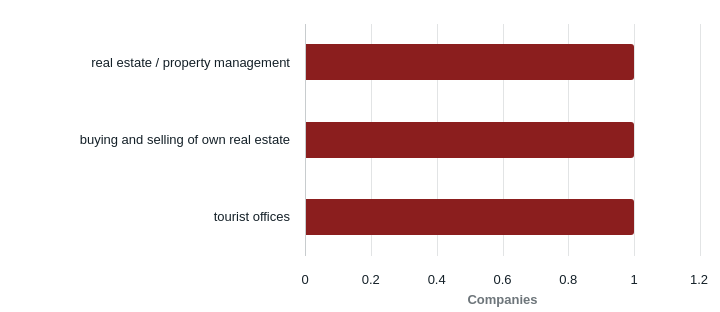
Vadsø maintains a low corporate default rate, reflecting the buffering effect of its stable public sector economy. Recent registry data records 3 bankruptcies in the municipality:
Bankrupt Entities Summary
- Miha Eiendom AS: Real estate / property management (Operating Income NOK 3.4M prior to liquidation, EBITDA NOK 1.6M, total debt NOK 23.1M).
- Greater Arctic Holding AS: Holding company (Ørtangen 10A, Vadsø).
- Visit Varanger Arctic Norway AS: Tourist office / destination marketing entity (Ørtangen 10A, Vadsø).
Insolvency Insights
| Industry Sector | Bankrupt Companies | Total Debt (NOK) | Operating Profit prior (NOK) |
|---|---|---|---|
| Real Estate / Property Management | 1 | 23.1M | 1.1M |
| Buying/Selling Own Real Estate | 1 | 0.0M | 0.0M |
| Tourist Offices | 1 | 0.0M | 0.0M |
Insolvencies are strictly isolated to property holdcos and tourism marketing, without systemic spillovers into main commercial sectors like automotive, logistics, or general trade.
Opportunities for Founders & Business Leaders
The structural features of Vadsø create clear strategic niches for entrepreneurs seeking low-volatility business environments:
Promising Entrepreneurial Areas
- B2B & Public Sector Services: With over 1,700 public administration employees and headquarters like Sykehusinnkjøp HF, high demand exists for IT consulting, specialized legal/financial advisory, facility management, and software support.
- Specialized Construction & Site Preparation: Site preparation in Vadsø currently yields high profit margins (25% EBITDA margin). Founders in specialized earthmoving, civil engineering, and green infrastructure can capture strong returns.
- Private Care & Health Support: Private operators like Prima Assistanse AS (NOK 23.1M sales, +10% growth) highlight expanding space for private healthcare, home help, and specialized social care services.
- Craft, Mechanics & Logistics: The automotive sector generates substantial turnover (NOK 570M+ across dealerships and repair shops). Opportunities exist in EV fleet maintenance, specialized transport, and heavy machinery repair.
- Sustainable Tourism & Hospitality: The exit of legacy marketing entities leaves room for modern, lean operators focusing on Arctic experience packaging, birdwatching tourism, and corporate retreats.
Prospective founders interested in exploring specific commercial addresses, property options, or sector statistics in Vadsø can use SmartGrunder to analyze market conditions and pinpoint local opportunities.
Conclusion
Vadsø represents one of Finnmark's most resilient municipal economies. Its core strength lies in its dual economic engine: public sector stability providing constant purchasing power and reliable employment, alongside established commercial pillars in trade, automotive services, energy, and transportation.
For local decision-makers and founders, Vadsø offers a predictable backdrop where public contracts, infrastructure investments, and essential local services present strong upside with reduced macroeconomic volatility.