Municipality
Economic Landscape and Entrepreneurial Opportunities in Vaksdal Municipality
An in-depth analysis of industrial revenue trends, local employers, business geography, and founder potential in Vaksdal
Executive Summary
Vaksdal municipality, strategically situated in Vestland county along the critical transport corridor between Bergen and Voss, presents a unique economic profile defined by heavy industrial legacy, hydro-electric power generation, grain processing, and high-value textile manufacturing. With major infrastructure links including the E16 highway and the Bergensbanen railway line, Vaksdal functions both as an industrial production hub and a commuter region linked to the broader Bergen region.
The municipal economy generated NOK 2.23 billion in business revenues in 2024, anchored by large-scale commercial operators such as Eviny Fornybar AS (Dale Kraftverk), Norgesmøllene AS, Felleskjøpet Vaksdal, and the iconic apparel manufacturer Dale Of Norway AS. Alongside these commercial pillars, public sector administration, healthcare, and primary education account for a substantial portion of local employment. For entrepreneurs and investors, Vaksdal offers stable utility infrastructure, deep manufacturing expertise, and strategic land access along key West Norway transit arteries.
Economic Overview
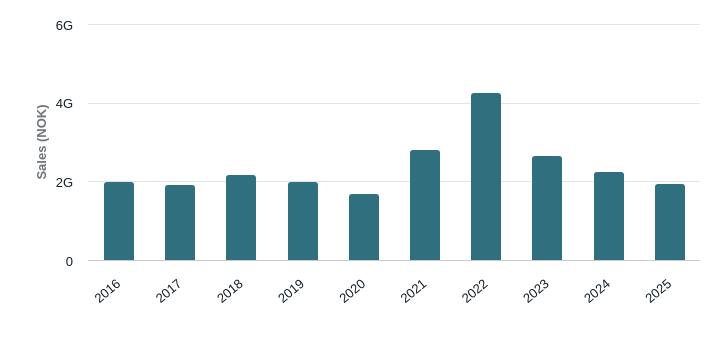
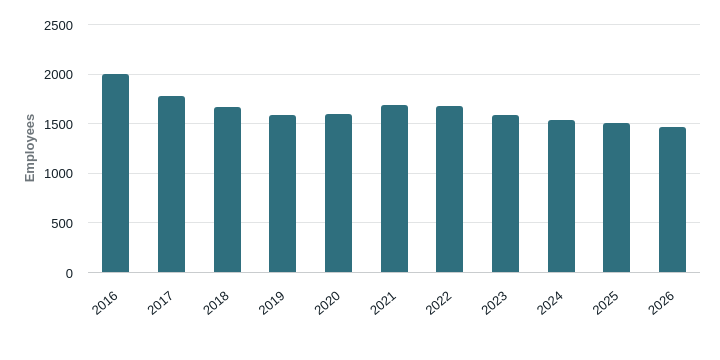
Vaksdal's macroeconomic trajectory over the past decade displays significant revenue volatility tied to energy prices alongside a gradual restructuring of overall private sector employment. Between 2016 and 2025, commercial turnover reached an extraordinary peak in 2022 during the Nordic power price surge, while total employment has adjusted downward to stabilize around 1,500 active roles across municipal and private enterprise.
The table below details the multi-year performance of sales revenue and total local workforce figures across Vaksdal:
| Year | Commercial Sales (NOK) | YoY Sales Growth | Total Employees | YoY Employee Growth |
|---|---|---|---|---|
| 2016 | 1,986.0M | — | 1,999 | — |
| 2017 | 1,918.0M | -3.4% | 1,774 | -11.3% |
| 2018 | 2,168.9M | +13.1% | 1,663 | -6.3% |
| 2019 | 1,983.7M | -8.5% | 1,584 | -4.8% |
| 2020 | 1,686.3M | -15.0% | 1,595 | +0.7% |
| 2021 | 2,786.6M | +65.2% | 1,682 | +5.5% |
| 2022 | 4,247.4M | +52.4% | 1,675 | -0.4% |
| 2023 | 2,633.6M | -38.0% | 1,582 | -5.6% |
| 2024 | 2,226.7M | -15.5% | 1,528 | -3.4% |
| 2025 | 1,933.8M | -13.2% | 1,506 | -1.4% |
| 2026 | — | — | 1,458 | -3.2% |
Note: The dramatic revenue expansion in 2021–2022 is largely attributable to hydro-power electricity price developments rather than organic volume changes in local labor.
The total workforce figures show that after a multi-year industrial rationalization from 1,999 positions in 2016, employment stabilized between 1,500 and 1,680 positions. Revenue trends reflect the high capital intensity of local energy generation, where top-line figures move independently of physical headcount.
Industry Structure & Corporate Organization
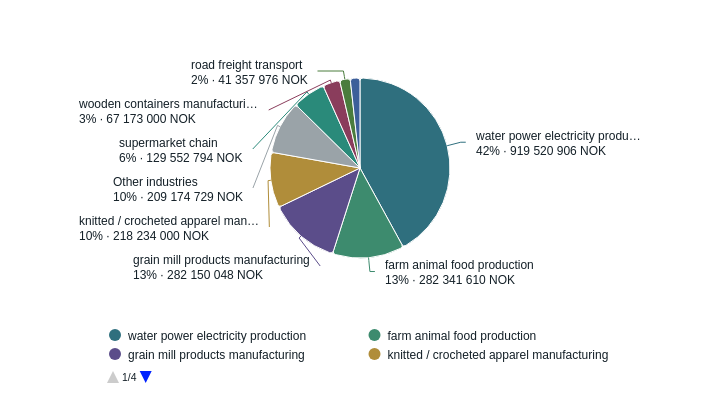
Vaksdal's economic base is highly concentrated in specialized capital-heavy sectors. The primary value drivers in the commercial domain include energy production, food product manufacturing, and textile production, complemented by a broad public sector footprint in municipal healthcare and education.
Key industry highlights based on active municipal industry statistics include:
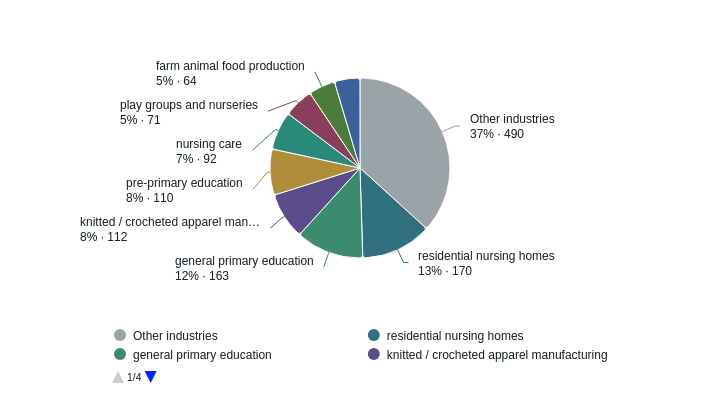
- Water Power Electricity Production: Operating income of NOK 926.2M across 36 employees, delivering an extraordinary operating profit of NOK 705.4M (76% operating margin) and an EBITDA per employee of NOK 20.1M.
- Grain Mill Products Manufacturing: Operating income of NOK 283.7M (36 employees), representing a core pillar of Norway's food security supply chain.
- Farm Animal Food Production: Operating income of NOK 282.3M (64 employees), generating high throughput in commercial feed distribution.
- Knitted & Crocheted Apparel Manufacturing: Operating income of NOK 233.7M with 112 employees, exhibiting strong export performance with an 18% revenue growth rate and NOK 41.4M EBITDA.
- Retail & Groceries: Supermarket chains generate NOK 131.9M in turnover across 50 employees, serving day-to-day consumer demand.
- Public Services & Municipal Care: Primary education (163 employees across 5 schools), residential nursing care (170 employees), and pre-primary education (110 employees) represent the largest continuous labor pools.
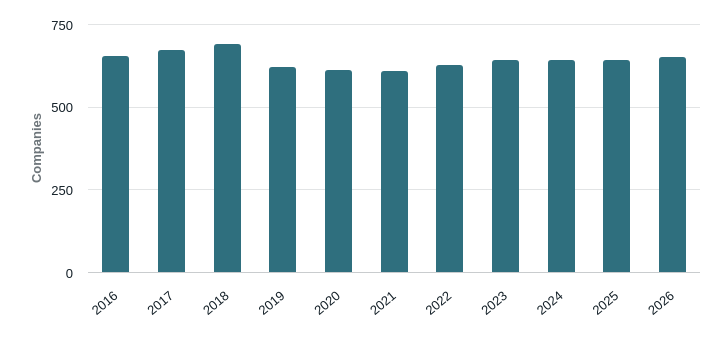
From an organizational structure perspective, limited liability companies (AS) generate NOK 1.85 billion in operating income across 51 entities (513 total employees), maintaining an impressive aggregate EBITDA margin of 46%. Cooperatives (SA) account for NOK 384.6M across 4 registered entities (98 employees), while municipal entities (KOMM) employ 856 workers across 28 functional units.
Business Geography & Regional Hubs
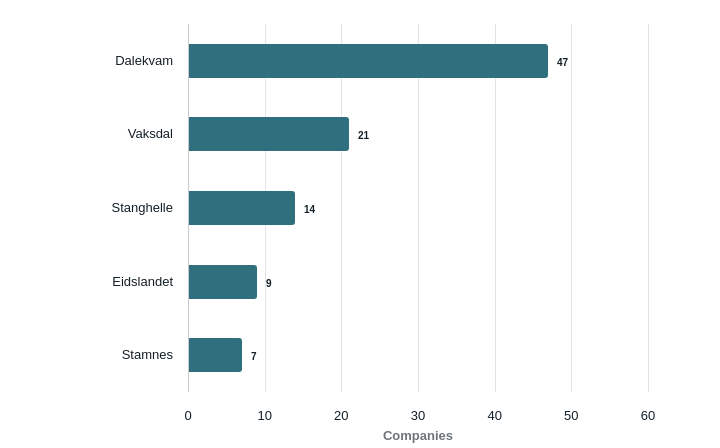
Commercial activity in Vaksdal is divided across distinct coastal and valley settlements along the Osterfjorden and Veafjorden systems. Each village fulfills a distinct role within the municipal economy:
| Area / Settlement | Active Companies | Employees | Operating Income (NOK) | Operating Margin | Key Local Characteristic |
|---|---|---|---|---|---|
| Dalekvam | 47 | 877 | 1,475.3M | 50% | Municipal administrative hub, textile manufacturing & hydroelectric generation |
| Vaksdal | 21 | 377 | 659.7M | 3% | Industrial milling, grain storage & animal feed production |
| Stanghelle | 14 | 125 | 32.3M | 0% | Residential village, local retail & transportation services |
| Stamnes | 7 | 74 | 16.7M | 1% | Fjord settlement, aquaculture support & primary industries |
| Eidslandet | 9 | 54 | 50.4M | 11% | Northern fjord area, high relative revenue growth (+38%) |
Dalekvam serves as the economic centerpiece, hosting nearly 60% of all municipal jobs and generating NOK 1.48 billion in operating income, aided by high-margin power production and specialized manufacturing. Vaksdal village acts as the industrial bulk processing hub, anchored by grain and feed operations at Kaivegen.
Largest Employers & Anchor Companies
The local economic backbone is sustained by a combination of long-standing industrial champions and public sector service providers. The largest employers registered in the municipality demonstrate high operational stability:
Top Commercial Employers
- Dale Of Norway AS (Dalekvam): 112 employees. Premium outdoor knitwear and textile manufacturer with NOK 233.7M operating income and NOK 27.3M operating profit.
- Felleskjøpet Vaksdal 2005 Fabrikk (Vaksdal): 64 employees. Large-scale agricultural feed manufacturing facility generating NOK 282.3M in annual sales revenue.
- Eviny Fornybar AS Avd Dale Kraftverk (Dalekvam): 36 employees. Major hydroelectric generation site delivering NOK 926.2M in operating income and NOK 761.1M EBITDA.
- Norgesmøllene AS Avd Vaksdal (Vaksdal): 36 employees. Strategic industrial mill facility yielding NOK 283.7M operating income.
Top Public Sector Employers
- Vaksdal Sjukeheim (Vaksdal): 96 employees (Residential nursing care).
- Vaksdal Kommune Eining For Heimetjeneste (Dalekvam): 92 employees (Home care services).
- Daletunet Omsorgssenter (Dalekvam): 74 employees (Elderly care center).
- Vaksdal Kommune Sentraladministrasjon (Dalekvam): 61 employees (Central administration).
- Dale Skule (Dalekvam): 57 employees (General primary education).
- Bueining For Funksjonshemma (Dalekvam): 54 employees (Specialized residential care).
Business Dynamism & Financial Stability
Vaksdal exhibits an exceptionally stable business environment characterized by low corporate turnover and minimal insolvency rates. The presence of mature industrial owners and municipal employers buffers the local economy against severe macroeconomic shocks.
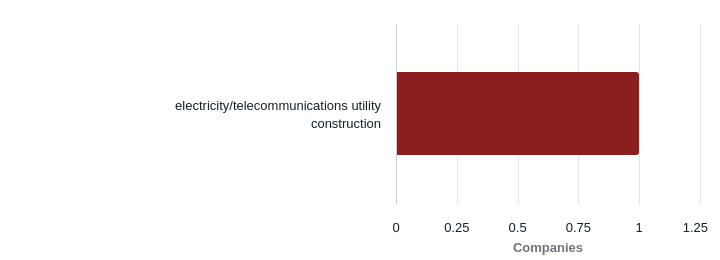
Over the evaluated reporting period, bankruptcy statistics record only 1 company failure within the municipality:
- Scandinetworks AS (Stavenesvegen 1, Vaksdal): Electricity and telecommunications utility construction company with 0 reported active employees and NOK 0 in annual operating revenue.
This low bankruptcy rate highlights the resilience of existing enterprise structures, though it also reflects a conservative local entrepreneurship ecosystem where new company formation occurs at a measured pace. The corporate landscape is heavily anchored by established corporations with long investment horizons.
Opportunities for Founders & Entrepreneurs
For prospective founders and expanding companies, Vaksdal offers targeted strategic advantages, particularly in industrial servicing, green energy utilization, and regional logistics.
Key entrepreneurial opportunities include:
- Industrial & Mechanical Services: Supplying maintenance, automation, and technical support services to high-throughput processing plants (milling, feed manufacturing, and textiles).
- Logistics & Transport Solutions: Exploiting Vaksdal's position along the E16 and rail network to offer specialized freight handling, storage, and last-mile distribution.
- Eco-Tourism & Heritage Commerce: Leveraging the global brand recognition of Dale Of Norway to develop fjord-based outdoor tourism, artisan food production, and cultural hospitality experiences.
- Commercial Service Provision: Providing specialized accounting, IT support, and administrative solutions to local SMEs and expanding branch operations.
Founders interested in establishing a business or exploring commercial real estate across Dalekvam, Vaksdal, or Stanghelle can utilize platforms like SmartGrunder to analyze demographic micro-trends, assess local market coverage, and evaluate competitive placement.
Conclusion & Strategic Outlook
Vaksdal municipality stands as a resilient industrial power-node within Vestland county. With high-margin hydroelectric generation at Dale Kraftverk and essential national manufacturing infrastructure in grain milling, animal feed, and textiles, Vaksdal provides a solid macroeconomic foundation.
While traditional industrial sectors maintain high capital productivity, expanding the local economy will require fostering new service-oriented startup activity, enhancing commuter linkages to Bergen, and capturing value along local tourism corridors. The municipality offers stable baseline conditions, strong physical infrastructure, and clear growth potential for targeted commercial ventures.