Municipality
Vefsn Business Economy Analysis: Industrial Core and Commercial Landscape
An in-depth economic evaluation for entrepreneurs, investors, and municipal decision-makers in Vefsn
Executive Summary
Vefsn serves as a primary industrial and commercial pillar in the Helgeland region of Nordland, anchored by its municipal center, Mosjøen. The municipality combines high-value process manufacturing, power infrastructure, and regional public services to maintain a stable employment base of approximately 8,600 to 8,800 workers.
Key takeaways from the local market context include:
- Industrial Anchor: Heavy industry—led by aluminium production at Alcoa Norway As Avd Mosjøen (802 employees)—and energy distribution via Linea As form the backbone of local revenue generation.
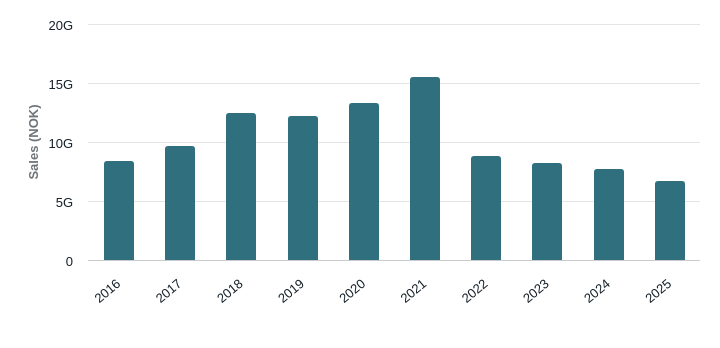
- Revenue Normalization: Total corporate sales peaked in 2021 at NOK 15.5 billion before adjusting toward NOK 6.7 billion in recent reporting cycles, reflecting global commodity price cycles and regional market adjustments.
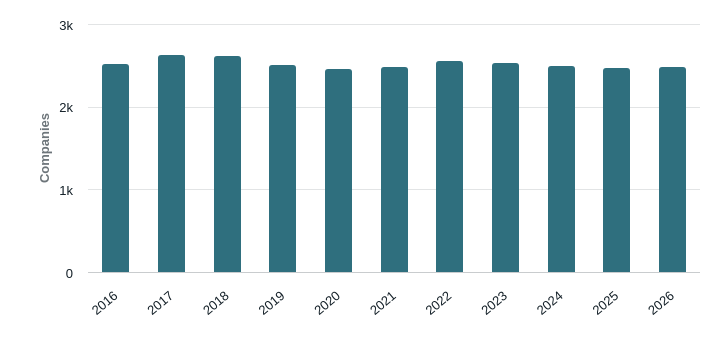
- Geographic Concentration: Economic activity is heavily centered in Mosjøen, which hosts 500 active commercial entities and over 9,000 employees.
- Foundational Services: Strong health, education, and municipal infrastructure provide a steady floor for local employment and B2B service opportunities.
Economic Overview
Vefsn's corporate sector experienced rapid top-line growth between 2016 and 2021, followed by a period of revenue moderation. Total turnover moved from NOK 8.4 billion in 2016 to a high of NOK 15.5 billion in 2021, largely influenced by energy and metal market volatility. Since 2022, overall sales revenue has normalized, reaching NOK 7.75 billion in 2024 and NOK 6.72 billion in 2025.
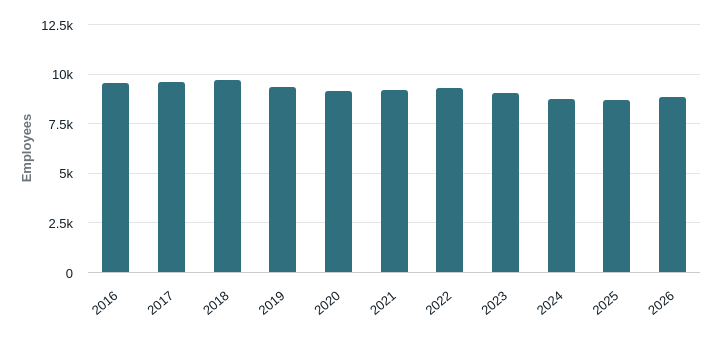
Employment levels have remained remarkably consistent over the same decade, fluctuating in a narrow corridor between 8,600 and 9,600 employees. The local workforce stabilized at 8,724 in 2024 and is projected to rebound to 8,825 by 2026.
| Year | Total Sales (NOK) | Sales YoY Change | Total Employees | Employees YoY Change |
|---|---|---|---|---|
| 2016 | 8.395 B | — | 9,510 | — |
| 2017 | 9.624 B | +14.6% | 9,573 | +0.7% |
| 2018 | 12.455 B | +29.4% | 9,658 | +0.9% |
| 2019 | 12.231 B | -1.8% | 9,342 | -3.3% |
| 2020 | 13.308 B | +8.8% | 9,148 | -2.1% |
| 2021 | 15.499 B | +16.5% | 9,164 | +0.2% |
| 2022 | 8.851 B | -42.9% | 9,276 | +1.2% |
| 2023 | 8.183 B | -7.6% | 9,012 | -2.8% |
| 2024 | 7.752 B | -5.3% | 8,724 | -3.2% |
| 2025 | 6.715 B | -13.4% | 8,657 | -0.8% |
| 2026 | — | — | 8,825 | +1.9% |
Note: Operating values reflect compiled corporate filings; year-over-year figures capture broader macroeconomic shifts in primary regional export sectors.
Industry Structure
Vefsn's industrial matrix balances capital-intensive private industries, retail, trade, and extensive public infrastructure. Limited liability companies (AS) generate the vast majority of commercial sales (NOK 7.61 billion out of total operating income of NOK 7.93 billion) and employ 4,731 people across 353 entities.
Primary commercial sectors measured by employment and turnover include:
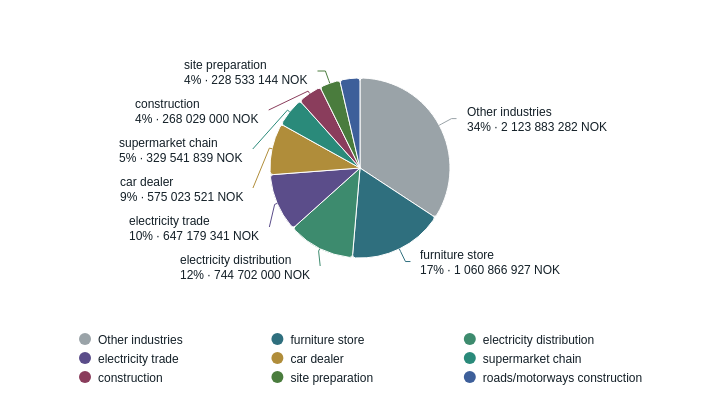
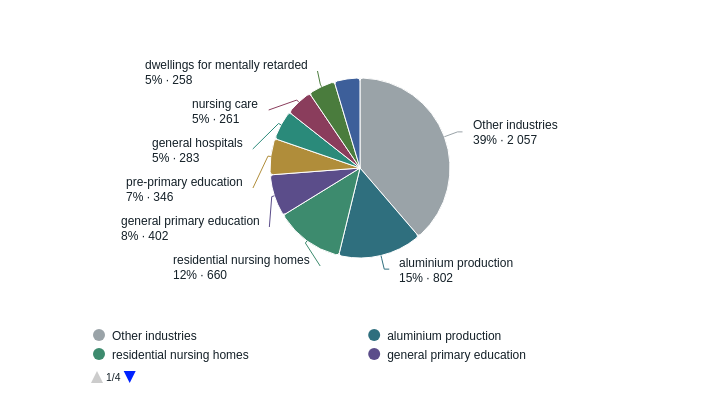
- Manufacturing & Energy: Aluminium production remains the flagship industry with 802 direct employees in a single industrial installation. Electricity distribution (2 companies, 139 employees) delivers high financial weight, generating NOK 856.8 million in operating income with strong EBITDA margins (19%).
- Construction & Technical Infrastructure: Construction (23 companies, 173 employees, NOK 272.2M turnover), site preparation (14 companies, 164 employees, NOK 231.3M turnover), and electrical installation (4 companies, 81 employees, NOK 100.1M turnover) supply essential civil engineering capabilities.
- Trade & Automotive: Automotive sales and service form a major economic cluster. Car dealers (6 companies, 100 employees) generate NOK 577.8 million in operating income, while car repair (11 companies, 103 employees) generates NOK 207.1 million.
- Public Services & Healthcare: Municipal entities (Komm, 62 organizations, 2,611 employees) and state enterprise units (Sær, 7 organizations, 487 employees) represent a significant portion of healthcare, eldercare, and secondary education in Helgeland.
| Industry Sector | Active Companies | Employees | Operating Income (NOK) | Revenue Growth |
|---|---|---|---|---|
| Aluminium Production | 1 | 802 | Confidential/Group | 0% |
| Residential Nursing Homes | 5 | 660 | — | 0% |
| General Primary Education | 7 | 402 | 4.5M | -13% |
| Pre-Primary Education | 18 | 346 | 69.0M | +3% |
| General Hospitals | 3 | 283 | 515.4M | +9% |
| Hotel & Accommodation | 3 | 194 | 131.5M | -4% |
| Construction | 23 | 173 | 272.2M | +14% |
| Site Preparation | 14 | 164 | 231.3M | -10% |
| Electricity Distribution | 2 | 139 | 856.8M | +2% |
| Car Dealers | 6 | 100 | 577.8M | +10% |
Business Geography
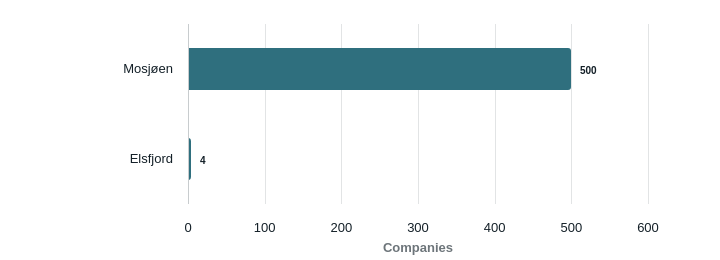
Commercial and industrial activity in Vefsn is highly centralized in Mosjøen, which acts as the economic engine for the municipality and neighboring rural areas.
- Mosjøen: Functions as the regional administrative, medical, and industrial capital. It registers 500 corporate entities, accounting for 9,036 employees, NOK 9.61 billion in operating income, and NOK 8.13 billion in sales revenue. Average revenue per employee in Mosjøen stands at NOK 2.5 million, with operating margins averaging 6%.
- Elsfjord: Represents a smaller rural center supporting local enterprise. The hub registers 4 companies employing 17 workers, generating NOK 8.7 million in operating income and NOK 4.1 million in sales revenue.
This distribution emphasizes Mosjøen's role as the primary location for new physical storefronts, logistical facilities, and service businesses.
Largest Employers
Employment in Vefsn is anchored by major industrial corporations, regional healthcare institutions, and public educational bodies.
Prominent local enterprise employers include:
- Alcoa Norway As Avd Mosjøen Prod Aluminium: The largest single industrial employer in the region, with 802 employees dedicated to primary aluminium processing.
- Vefsn Sykehjem: Municipal residential nursing facility operating with 344 employees.
- Helgelandssykehuset Hf Mosjøen Somatikk/administrasjon: Regional hospital facility with 269 employees and NOK 475.4 million in operating income.
- Mosjøen Videregående Skole: Upper secondary and technical education institute employing 245 staff.
- Parken Bo Og Servicesenter: Municipal care center employing 130 people.
- Team Helgeland As: Hospitality operator (hotels) employing 115 staff with NOK 72.2 million in operating income.
- Mosjøen Politistasjon: Public safety and law enforcement headquarters employing 108 staff.
- Linea As Mosjøen: Key regional power grid distribution utility with 100 employees and NOK 752.4 million in operating income.
- Fredlundskogen: Municipal care service employing 99 staff.
- Medvind Assistanse As Avd Helgeland: Home care assistance provider with 98 employees.
- Jobzone Norge As Avd Helgeland: Staffing and recruitment service maintaining 81 employees with NOK 13.1 million in operating income.
Business Dynamism & Risk Factors
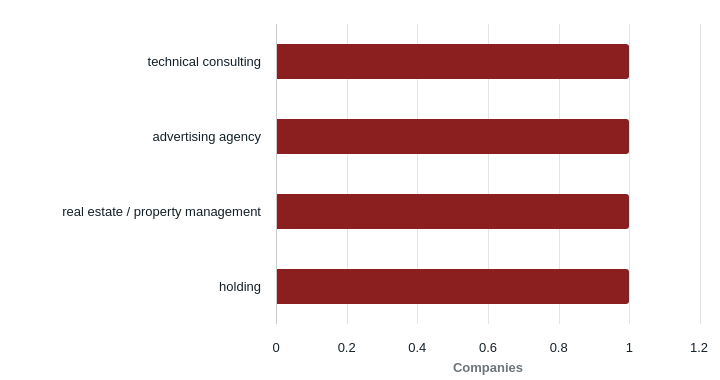
Insolvency data indicates a stable commercial climate with minimal corporate distress across core operational sectors. Recorded bankruptcies are low and concentrated in micro-entities and holding structures.
Recorded bankruptcies in Vefsn cover 4 companies across specific holding and specialized service lines:
- Technical Consulting: 1 company (Nordland Gear Inspeksjon As; NOK 212.0K sales revenue).
- Real Estate / Property Management: 1 company (Skade As; NOK 0 sales revenue, NOK -15.1M operating profit).
- Holding Companies: 1 company (Tlh Invest As; NOK 0 sales revenue, NOK -15.1M EBITDA impact).
- Advertising Agency: 1 company (Rubin As; NOK 0 sales revenue).
Core industrial sectors—including heavy manufacturing, grid utilities, auto trade, and specialized construction—demonstrate strong balance sheet resilience without elevated insolvency spikes.
Opportunities for Founders
Vefsn's unique structure—combining energy-intensive manufacturing, public healthcare hubs, and regional trade—creates targeted avenues for growth-focused entrepreneurs.
Key entrepreneurial opportunities include:
- Industrial & B2B Services: Subcontracting opportunities in maintenance, specialized technical consulting, logistics, and automation tailored to heavy industry and electrical utilities.
- Green Transition & Infrastructure Support: Services focused on energy efficiency, circular economy solutions for industrial byproducts, and site preparation support.
- Commercial Trade & Automotive Services: Given that car dealers and repair facilities generate over NOK 780 million combined, specialized automotive technology, EV fleet maintenance, and transport services have clear addressable demand.
- Hospitality & Business Travel: Anchored by operators like Team Helgeland As (NOK 72.2M revenue), business travel and regional tourism offer sustained demand for specialized food, beverage, and accommodation concepts.
For entrepreneurs evaluating business locations or sector entry points across Vefsn, tools like SmartGrunder can assist in exploring localized commercial addresses and industry statistics.
Conclusion
Vefsn presents a resilient, industrially grounded municipal economy within Nordland. With Mosjøen serving as an established hub for manufacturing, healthcare, and utility distribution, the local economy offers a dependable backdrop for new business creation.
While macroeconomic normalization has moderated total revenue from the peak levels of 2021, steady employment numbers above 8,600 and low insolvency rates highlight a mature, sustainable market environment. Strategic investors and founders who align their value propositions with Vefsn's industrial ecosystem and regional service needs will find a solid foundation for long-term venture growth.