Municipality
Vennesla Municipal Economy: Industrial Tradition, Spatial Geography, and Entrepreneurial Landscape
An in-depth economic analysis for founders, investors, and local decision-makers in Agder
Executive Summary
Vennesla, situated in Agder county just north of Kristiansand, possesses a distinct economic profile rooted in industrial manufacturing, heavy construction, specialized engineering, and a substantial public welfare sector. As one of Agder's traditional industrial hubs, the municipality has evolved from its historical pulp and paper heritage into a diversified economy featuring high-tech instrument production, wood-based manufacturing, site preparation, and experiential tourism.
Key structural highlights of the Vennesla economy include:
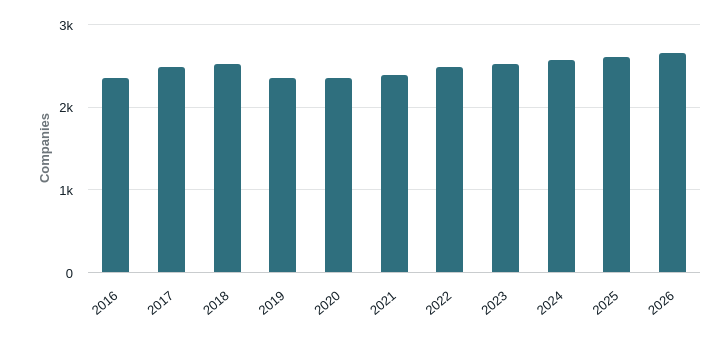
- Total Business Activity: Over 2,600 registered enterprises, generating more than NOK 5.0 billion in annual sales and employing between 5,600 and 6,500 people across public and private sectors.
- Core Private Industries: Wood manufacturing (led by Huntonit AS), specialized construction and civil engineering (Vef Entreprenør AS, Holbæk Anlegg AS), advanced electronics/measuring instrumentation (Tratec Norcon AS), and technical consulting.
- Commercial Hubs: The commercial center of Vennesla accounts for over 85% of total local employment and business revenue, complemented by rural industrial and agricultural pockets in Øvrebø and Hægeland.
- Reinvestment & Transformation: Successful adaptive reuse of historical industrial assets, most notably Hunsfos Næringspark (Hunsfos Opplevelse AS), which has created a thriving destination for commercial events, culture, and services.
While macroeconomic headwinds in construction and building materials have moderated overall revenue growth in recent years, Vennesla offers a competitive cost base, strong municipal infrastructure, and close proximity to the Kristiansand regional market.
Economic Performance & Macro Trends
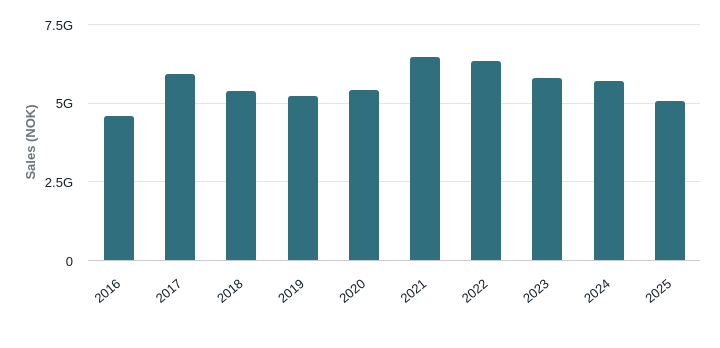
Vennesla's aggregate corporate revenue and workforce dynamics reflect macroeconomic cycles in the construction and manufacturing sectors across Southern Norway. Following a strong post-pandemic expansion that reached a revenue peak of NOK 6.44 billion in 2021, total local business turnover experienced moderate contractions through 2023–2025, settling near NOK 5.06 billion.
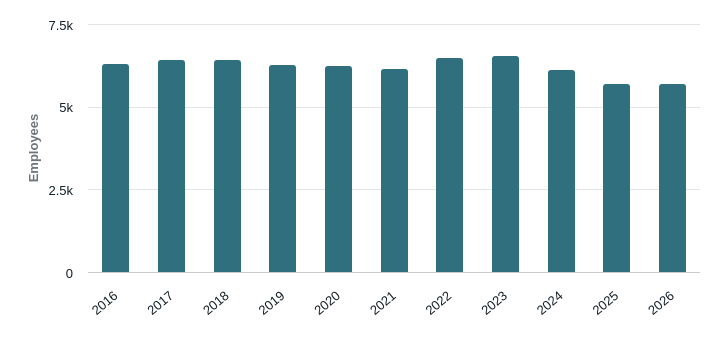
Employment levels remained resilient above 6,400–6,500 personnel through 2022–2023 before adjusting downward to around 5,700 employees in 2025–2026, driven primarily by headcount rationalization in cyclical construction, specialized trades, and manufacturing sub-sectors.
Historical Revenue & Employment Trends
| Year | Annual Revenue (NOK) | Revenue YoY Change | Total Employees | Employment YoY Change |
|---|---|---|---|---|
| 2016 | NOK 4,578.6M | — | 6,278 | — |
| 2017 | NOK 5,914.6M | +29.2% | 6,401 | +2.0% |
| 2018 | NOK 5,373.7M | -9.1% | 6,403 | +0.0% |
| 2019 | NOK 5,197.9M | -3.3% | 6,250 | -2.4% |
| 2020 | NOK 5,390.0M | +3.7% | 6,217 | -0.5% |
| 2021 | NOK 6,437.6M | +19.4% | 6,125 | -1.5% |
| 2022 | NOK 6,329.9M | -1.7% | 6,466 | +5.6% |
| 2023 | NOK 5,768.2M | -8.9% | 6,521 | +0.9% |
| 2024 | NOK 5,673.1M | -1.6% | 6,095 | -6.5% |
| 2025 | NOK 5,062.9M | -10.8% | 5,695 | -6.6% |
| 2026 | — | — | 5,692 | -0.1% |
Despite recent revenue tightening, the local corporate sector maintains a solid aggregate operating profit margin of approximately 12–13% across limited liability companies (AS), underpinned by high-margin utility, engineering, and specialized manufacturing activities.
Industry Mix & Legal Structure
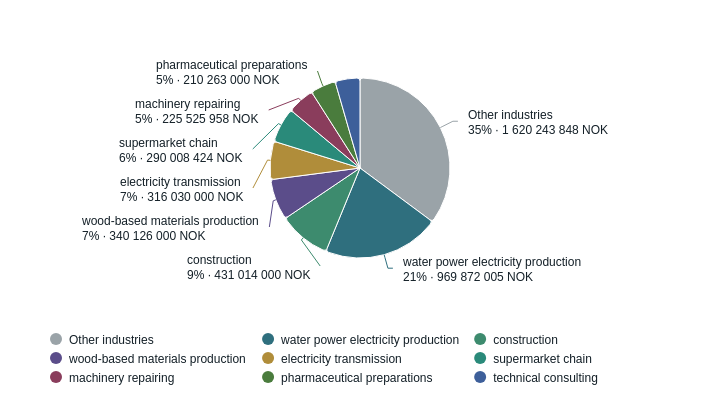
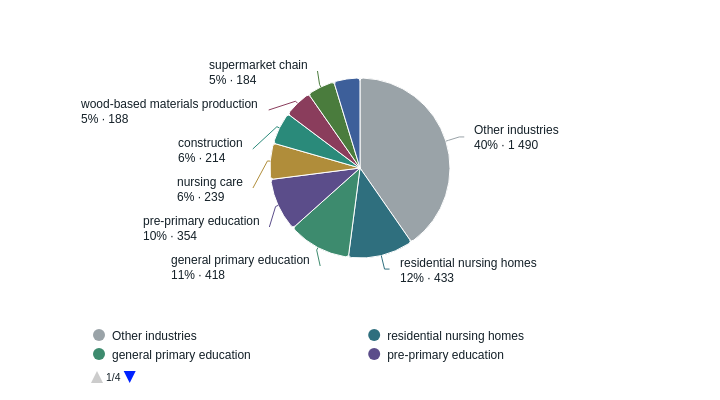
Vennesla's industrial structure exhibits a dual balance between a heavy municipal public service footprint and a diverse, private industrial base. A breakdown of key sectors reveals significant concentration in building materials, construction services, healthcare, education, and technical instrumentation.
Major Industry Statistics
| Industry Sector | Companies | Employees | Operating Income | Operating Margin | EBITDA Margin |
|---|---|---|---|---|---|
| Construction (General & Civil) | 25 | 214 | NOK 433.1M | 4% | 5% |
| Wood-Based Materials Production | 1 | 188 | NOK 340.3M | 4% | 7% |
| Supermarket Chains & Grocery | 9 | 184 | NOK 293.8M | 1% | 1% |
| Technical Consulting | 14 | 103 | NOK 208.1M | 8% | 8% |
| Measuring & Navigation Instruments | 1 | 78 | NOK 198.7M | 7% | 8% |
| Site Preparation & Earthworks | 8 | 92 | NOK 165.8M | 6% | 10% |
| Roofing Activities | 3 | 74 | NOK 118.2M | 5% | 6% |
| Painting & Glazing | 3 | 66 | NOK 75.2M | 9% | 10% |
| Road Freight Transport | 11 | 68 | NOK 64.6M | 3% | 5% |
| Drug Treatment Specialist Health | 1 | 76 | NOK 54.0M | 8% | 10% |
| Adventure, Events & Activities | 1 | 120 | NOK 32.5M | 8% | 8% |
Corporate Legal Forms
Limited liability enterprises (Aksjeselskap - AS) represent the overwhelming driver of commercial activity, comprising 277 wage-paying companies, 3,057 private employees, and NOK 5.33 billion in combined operating income. Municipal entity structures (Kommune - KOMM) represent the second-largest organizational category with 51 administrative units and 2,216 employees covering schools, eldercare, and municipal administration.
Cooperatives (SA) and state-owned enterprises (SF) also play strategic roles, with state utility and energy management accounting for high revenue output relative to workforce size.
Business Geography & Local Centers
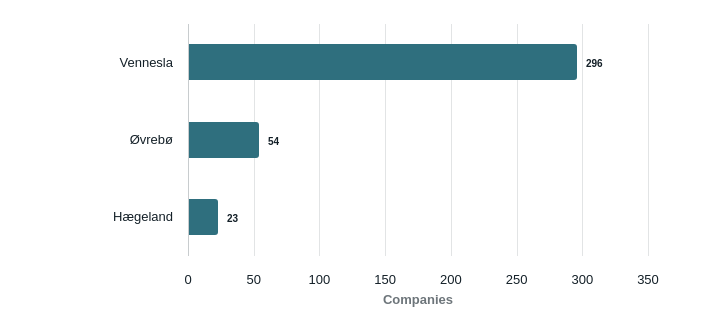
Commercial and industrial activity in Vennesla is divided into three distinct spatial areas: the urban core of Vennesla, the central sub-area of Øvrebø, and the northern rural area of Hægeland.
Geographic Activity Breakdown
| Location / Settlement | Companies | Total Employees | Operating Income | Sales Revenue | EBITDA Margin |
|---|---|---|---|---|---|
| Vennesla (Town Center & Industrial Parks) | 296 | 4,984 | NOK 4,873.9M | NOK 4,699.5M | 15% |
| Øvrebø | 54 | 547 | NOK 755.2M | NOK 737.4M | 16% |
| Hægeland | 23 | 265 | NOK 206.7M | NOK 206.2M | 4% |
Spatial Characteristics
- Vennesla Center & Hunsfos: The primary economic heartland. Host to major industrial plants (Huntonit AS), technical suppliers (Tratec Norcon AS), large construction firms (Vef Entreprenør AS), and the converted Hunsfos Næringspark, which houses cultural operators, retail, and technology firms.
- Øvrebø: Located along key transportation corridors, Øvrebø hosts specialized civil contracting (Øvrebø Industriområde), healthcare institutions (Blå Kors Klinikk Loland AS), primary education, and local agriculture-related businesses.
- Hægeland: Situated on the northern axis along Setesdalsvegen (Riksvei 9), Hægeland serves as a gateway to the Setesdal region, with local retail, healthcare services (Hægelandsheimen), site preparation, and transport facilities.
Largest Employers & Key Corporate Players
Employment in Vennesla is anchored by large public municipal entities alongside established industrial manufacturers and civil infrastructure firms.
Key Employers in Vennesla
#### Public Sector & Institutions
- Vennesla Kommune Venneslaheimen: 278 employees (Residential nursing care)
- Vennesla Kommune Enhet For Hjemmetjeneste: 239 employees (Home nursing services)
- Vennesla Videregående Skole: 114 employees (Technical and vocational secondary education)
- Vennesla Kommune Hægelandsheimen: 102 employees (Residential eldercare in Hægeland)
- Vennesla Skole & Vennesla Ungdomsskole: 97 and 88 employees respectively (Primary education)
#### Private Sector Anchor Companies
| - Huntonit AS: 188 employees | NOK 340.3M Operating Income |
|---|
A flagship Norwegian manufacturer of pre-painted wall and ceiling boards, operating a major production facility at Venneslavegen.
| - Hunsfos Opplevelse AS: 120 employees | NOK 32.5M Operating Income |
|---|
A major regional event, dining, and cultural destination situated in the transformed industrial park at Hunsfos.
| - Vef Entreprenør AS: 92 employees | NOK 242.5M Operating Income |
|---|
A leading regional building contractor specializing in commercial construction, residential development, and public infrastructure projects.
| - Tratec Norcon AS (Avd Vennesla): 78 employees | NOK 198.7M Operating Income |
|---|
Specialists in industrial automation, SCADA systems, measuring instrumentation, and electrical control systems.
| - Blå Kors Klinikk Loland AS: 76 employees | NOK 54.0M Operating Income |
|---|
Specialized health service provider operating drug treatment and rehabilitation facilities in Øvrebø.
| - Holbæk Anlegg AS (Avd Grunnarbeid): 68 employees | NOK 134.2M Operating Income |
|---|
Major site preparation, earthmoving, and civil engineering firm operating out of Tjønnvoll Industriområde.
Business Dynamism & Bankruptcy Statistics
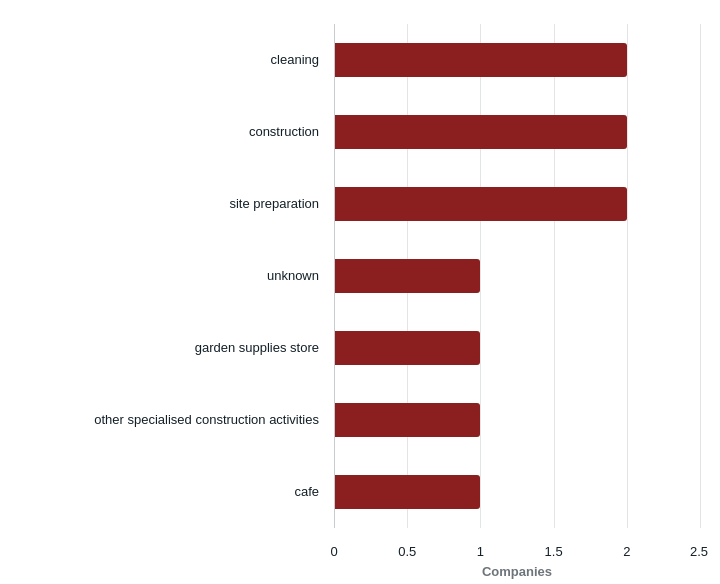
Vennesla's business ecosystem demonstrates standard structural reallocation. Over recent reporting periods, bankruptcies have been primarily concentrated in highly cyclical sub-sectors such as residential building, specialized subcontractor trades, and small-scale consumer retail/hospitality.
Bankruptcy Summary by Sector
| Industry Sector | Bankrupt Companies | Combined Revenue Impact | Financial Characteristics |
|---|---|---|---|
| Building Construction | 2 | NOK 18.8M | Capital-intensive firms impacted by rising interest rates and reduced housing demand (e.g., To8 Bygg AS). |
| Site Preparation & Earthworks | 2 | NOK 2.3M | Civil earthmoving operators facing high equipment debt and cost inflation (e.g., B Mt AS). |
| Garden Supplies & Florists | 1 | NOK 2.6M | Retail margin pressures and changing consumer discretionary spend (e.g., Markens Blomster AS). |
| Cleaning Services | 2 | NOK 0.0M | Shell or inactive micro-entities with zero reported sales. |
| Specialized Trades & Hospitality | 3 | NOK 0.0M | Early-stage or inactive ventures in scaffolding, roadwork, and catering (e.g., Stillas Solutions Vennesla AS, Yuis Wok & Nudler AS). |
Overall, the insolvency rate in Vennesla remains manageable and reflects national macroeconomic trends in construction and retail rather than localized structural decline. Well-capitalized industrial leaders in the municipality continue to maintain healthy balance sheets.
Opportunities for Founders & Entrepreneurs
Vennesla presents strategic advantages for new businesses seeking lower operating overheads while staying within a 15-minute drive of Kristiansand's urban market and port infrastructure. Key opportunity areas for founders include:
- Industrial Automation & Green Tech Services: With strong incumbents like Tratec Norcon AS and Huntonit AS, there is steady demand for specialized subcontractors in sensor tech, industrial energy efficiency, machine maintenance, and circular material reuse.
- Experiential Tourism & Hospitality: The success of Hunsfos Opplevelse AS demonstrates growing consumer demand for culture, dining, and event venues in repurposed historic venues. Opportunities exist in boutique hospitality, outdoor adventure along the Otra river, and specialized gastronomy.
- Craft Trades & Sustainable Renovation: As new building construction stabilizes, demand for energy-retrofitting, painting, roofing, and specialized trade renovation services remains elevated across the regional housing stock.
- B2B Professional & Logistics Services: Vennesla's industrial parks (such as Tjønnvoll, Øvrebø, and Vigeland Brug) offer competitive commercial lease spaces for logistics, equipment rental, and technical consultancy.
Founders evaluating site selection, competitive density, and sector revenue in Vennesla can leverage platform tools such as SmartGrunder to analyze street-level business density, commercial registration trends, and market openings across Agder.
Conclusion
Vennesla combines a resilient industrial tradition with a flexible modern economy. While short-term macroeconomic adjustments in construction and timber manufacturing have tempered aggregate top-line growth, the municipality's core strengths—diverse technical expertise, high-quality public services, active industrial parks, and proximity to Kristiansand—provide a reliable foundation for enterprise.
For entrepreneurs, decision-makers, and prospective investors, Vennesla represents an accessible, industrial-friendly municipality with high commercial capacity and strategic long-term development potential.